Showing posts with label Biography. Show all posts

Saturday, June 17, 2017

"I'm 'A', Obviously": Happy Birthday to the Real Anastasia

June 18th is the birthday of one of the most adored young women of recent world history. You may know her as the Grand Duchess Anastasia Nicholaievna, fourth daughter of Tsar Nicholas II. 


Pinterest


Her family, however, knew her as the resident schvibzik, which is Russian for "Imp," because of what a prankster she was.


Grand Duchess Anastasia
Pinterest


No, I'm not lying. 


People have impersonated her, novels and movies have been written about her, myths have been blown out of proportion, but the real Anastasia and her family continue to delight and fascinate everyone--including yours truly.


This is Anastasia when she was fifteen--the current age of my baby sister.


Grand Duchess Anastasia 1916:
Pinterest

Being a 90s kid, of course, the 1997 fantasy Anastasia blew my mind (and it's still one of my favorite movies ever, and it's now spawned a really awesome Broadway musical). But that, of course, was just a small taste of what Anastasia's real story had to offer. 


When I was older, I came across the Royal Diaries series, and Anastasia: The Last Grand Duchess by Carolyn Meyer immediately caught my attention. I read it multiple times and there are lines that I can still (almost) quote by heart (including the one I used for the title of this post):


“Tatiana says that if I eat too much blini I will turn into a blin. That could prove interesting!”
"Someday I will dye my hair red and wear a veil. Won't Mama be appalled!
"My derriere hurts" Say 'figure', Anastasia!' snaps Tatiana. "Okay, then the part of my body that was in contact with a saddle for the last three hours hurts!"
"Grandmama forbade all talk of the war and asked me instead about my French studies--that, of course, proved to be a total disaster."
"Why wasn’t I born knowing all these languages?
"I wanted to KICK Derevenko"
"I was hoping we would be free of lessons until we were truly free. No such luck"


Remarking about riding their bikes down the halls of the Alexander Palace with Marie: "so far we have had several spectacular crashes"
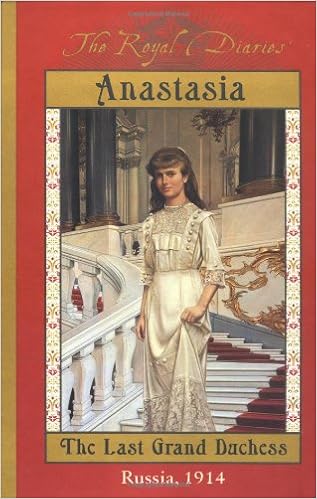
Image result for the royal diaries anastasia
Amazon

More than any other title in the Royal Diaries Series, The Last Grand Duchess made the subject likeable and real to the reader. But more than any other royal family in history, the family of Tsar Nicholas II--Empress Alexandra, Olga, Tatiana, Marie, Anastasia, and Alexei--are a lot more real and accessible to people today because of how well-documented their lives were. Nicholas took tons of photos--and some of them were really, really candid.

Tsar Nicholas II and Grand Duchess Tatiana Nikolaevna Romanova of Russia.:
Nicholas with Tatiana, Pinterest

There's this family photo that is too reminiscent of the painfully awkward family photos of today, Anastasia is on the far right:
Anastasia's like THESE BANGS I HATE THESE BANGS:
Pinterest
Sometimes historical figures are actually way too #relatable.

"Hey, Olga, can you get out of bed?" "NO"
Also, note that the bedding is not super-fancy
(Mashable)

Just being a normal family here. Move along.

Tatiana, Olga, Maria and Anastasia:
Pinterest :) 

Sometimes it blows my mind that something referenced in a fictional diary actually happened. I remember Anastasia talking about Olga's public presentation when she turned sixteen: here is a photo from that very event.
Olga Romanov looking beautiful on her 16th birthday, beside her members of her regiment:
Pinterest

One thing that Meyer describes in the fictional diary is the Romanov family tradition of building a huge snow fort/mountain every winter. This is the one they built in Tobolsk, Siberia, before the guards decided to tear it down.


Snow fort built by the Tsar, his daughters and soldiers during captivity in Tobolsk Siberia before it was ordered destroyed because the prisoners could look out over the wooden fence to the outside world.
Pinterest


They're royalty, but at the same time they're the family down the street. Reading their story just makes you feel, not to be tacky or anything, right at home. I mean, they look almost like anybody's kids. We love them because we relate to them. And we have access to everything they made because it all happened a hundred years ago or more--no privacy rules, no social media, everything is fair game to their fans.

“Children of the last Russian Tsar playing aboard the imperial yacht Polar Star, 1905”:
Pinterest--Anastasia on the right

And of course, we still have many of their real letters and diaries and first-hand accounts from the people who knew them. You get the sense that the Romanovs loved each other very much. True, they pulled back from the public spotlight quite a bit because they didn't want anyone to know that the baby brother, Alexei, had hemophilia. So they kind of had to be close. But they got to be a real family.

Tsarina Alexandra with her son Tsarevich Alexei Romanov. as Alexis was diagnosed as a haemophiliac and was not expected to live long. Both parents devoted much time to the boy and left the government of Russia to others. Alexandra was a very protective mother, but she was also determined to see that her son became tsar. Alexandra believed that she was more suited to do this than her husband::
Empress Alexandra with Alexei. Alexei did not want his illness to keep him
from having fun like any other boy, as we can see in this photo (Pinterest)

The four sisters, Olga, Tatiana, Marie, and Anastasia, were known collectively as OTMA. They were that tight.

The four Romanov sisters in 1914.A♥W:
OTMA in 1914, the year part of The Last Grand Duchess is set. Anastasia on the left. (pinterest)

The real Anastasia was feisty, sassy and spirited.


"Grand Duchess Anastasia grew into an energetic child. She was the shortest of the daughters and the least ethereal, with dark blonde hair and blue eyes. What everyone remarked on was her quickness and sense of humor. She loved mischief and playing tricks, not all of them nice... Anastasia was known to trip people; her cousins complained she played too rough. Anastasia didn’t seem to care. She climbed trees and adored animals. She ate chocolates with her gloves on. She was a brilliant mimic and shone in family theatricals. Anastasia disliked her lessons and showed little aptitude for grammar or spelling, but she was considered by some the most intelligent of the four daughters." 

Maria Nikolaevna & Anastasia Nikolaevna on Horn Island (Vyayke-Pakri), 1912:
Anastasia with Marie. Same of the pictures she's in show her with a bit of attitude. (Pinterest)

A more detailed account from Your Dictionary:

Nicknamed shvibzik, meaning "imp, " Anastasia was mischievous, and loved making others laugh. She delighted in mimicking pompous guests, as well as instigating pranks on nurses and tutors. In his memoirs, her French tutor, Pierre Guillard, wrote, "She was the imp of the whole house and the glummest faces would always brighten in her presence, for it was impossible to resist her jokes and nonsense."
Anastasia did not enjoy most of her schoolwork. According to Hugh Brewster, author of Anastasia's Album, her English teacher remembered her trying to bribe him with flowers so he would raise her poor marks. When he refused, she gave them to her Russian teacher. She adored creative subjects, however, and wrote, "I excelled at composition. I must say that all my poems were satires, lampoons, from which no one was safe." Her drawings, paintings, and photographs are well documented in family albums. She often spent hours illustrating letters with drawings, and hand-coloring photographs to highlight a special aspect.
Sometimes the truth is stranger than fiction. 

Like the Grand Duchess Anastasia, I too had really long hair and bangs until I was in my late teens. I feel your pain, gurl.  
Anastasia with her father - What if?:
Anastasia with her father. Pinterest

She would really have loved the 21st century--she mastered the art of selfies before selfies were a thing.
"I took this picture of myself looking at the mirror. It was very hard as my hands were trembling."-exerpt from a letter written by Anastasia to her father on October 28, 1914:
"I took this picture of myself looking at the mirror. It was very hard as my hands were trembling."
-excerpt from a letter written by Anastasia to her father on October 28, 1914
godsavethetsar.tumblr.com via Pinterest

Also making really weird faces. Can you believe that a real historical figure would do this? It's the absurdity of it that makes her appealing.

That's a face that could appall Mama!
Mashable

Honestly, if they get that feisty attitude across in the movies, more power to her.

It makes sense that the movie would have changed some of the details of the story. However, in other aspects they actually did their homework. 
My edit
On the left is a photo of the Dowager Empress Marie Feodorovna in her gown for the 1903 costume ball. On the right, of course, is the Dowager Empress in the movie Anastasia (1997), dressed for the costume ball in the opening scene. The outfits are not identical. BUT they do have similar design elements. The design of the crown in both, for instance, is similar, both having prongs above the fur brim and a veil in back. Both gowns have a narrow waist and similar horizontal and vertical bands. It's enough of a resemblance that when I saw the photo of the real gown I could tell that it was familiar. 

My edit
Far left, a screenshot of the princess gown and tiara from the movie. The middle panel is a portrait of Anastasia's oldest sister Olga wearing a court dress. The far right is Alexandra's coronation portrait. Notice the similarities of all three: the curved kokoshnik tiara, the sash around the front, lower shoulder line, and the long, open sleeves. To have confirmation that one of her gowns from the movie is based on the actual fashions of the Russian Imperial Court is astounding.  

And last but not least, prepare to have your mind blown:
(Screenshot from Pinterest)
Remember this line from the movie: "Olga made me so mad she said it looked like a pig riding a donkey!...She was right."

It's just so...affirming that the people who created the animated film went to those lengths to include some things from the world that the real Anastasia actually lived in. And then to have a random fictional diary include so much of the real details is thrilling. I think Anastasia is part of the reason I'm a history geek.


This year marks the centenary of the Russian Revolution. After Nicholas abdicated, he and his family were kept under house arrest in Tsarskoe Selo (palace compound outside of Saint Petersburg) for several months and then moved to Tobolsk, Siberia. When the Bolshevik/Communist Party took control of Russia, the Romanovs were moved to Ekaterinberg, where, in July of 1918, they were all brutally executed.  Anastasia was only seventeen. The remains of all the family members have since been found and identified. So, no fairy-tale ending here. But the important thing to remember is that she lived. She lived with her hair down and chocolate stains on her gloves. Dreaming about her escaping can be a fun pasttime. But celebrating Anastasia's life is the best way to go about remembering her--and we do that by living our own lives to the fullest.

Tuesday, March 1, 2016

You Had Me at "Hamilton"

It started when one of my theater geek friends posted a link to a news article on Facebook. Of course, with a name like Hamilton, and the premise being the story of an influential figure from the Revolutionary War period, a history buff like me couldn’t pass it up.
That was about the same time, of course, that the show became all the rage on Tumblr.  GIFs and fan art started appearing everywhere. I listened to most of the soundtrack while working on a sewing project and had a great time.

my edit

So for the record, I have heard of Alexander Hamilton. Anyone here remember the show “Liberty’s Kids” from back in the day? Young Colonel Hamilton’s first and most memorable appearance on that series was his ride with James to Morristown, where he shared his backstory about being orphaned in the Caribbean.  He didn’t mind being with James, since they were both “Gentlemen of Low Birth.” But other than that I never really paid attention to Hamilton, in real life or otherwise.
The real Alexander Hamilton was actually kind of a big deal.  I knew he fought in the Revolution and he was close to Washington.  I had no idea that he was pretty much Washington’s right-hand man. I knew he was at the Constitutional Convention but I didn’t know much about his participation. I knew that James Madison wrote a few of The Federalist Papers and John Jay added a few but I didn’t realize that “Hamilton wrote the other 51.”  I also knew that Hamilton was the first Secretary of the Treasury--hence why he’s on the ten-dollar bill.  But I had no idea that he helped Washington run the country during his first term as president and that a lot of his initiatives created the America we have today.  
Needless to say, I have not looked at a ten-dollar bill the same way since Hamilton came out.

Hamilton the Man

After listening to the soundtrack highlights, I decided to check out the eight-hundred-page Ron Chernow biography that inspired Lin-Manuel Miranda so I could learn more about this guy. Though I am an introvert I am a people person and a sucker for biographies: the best way to learn about history is through the lives of the people who shaped it. I got through half of it before Christmas.  I had to return it and I only just recently re-checked it from the library. 

Alexander Hamilton was many things: a war hero still ambitious for military glory after the fighting had ended; a loving husband and father as well as a scoundrel; a scholar and a diplomat, a finance guru, a lawyer; a loyal friend; an enthusiast of medicine; a politician who pushed his own ideas as well as a realist who understood the world around him; but most importantly to me personally, a writer.  True, a much different kind of writer than me, but someone who put his thoughts on paper.  The line from the musical “Why do you write like you’re running out of time” is not only accurate but it convinced me that, more than any other founder, Alexander Hamilton is my spirit animal.


Every founding father was brilliant in their own way, but they were so adamant about their different ideas that they couldn’t get along.  I am reminded of a statement that Joss Whedon once made about the Avengers: they don’t belong in the same room together.  Putting all of the big names in the American Founding together for the administration of the first president may have worked to unify the country at the start but it ended up creating the party system as people rallied to different figureheads. Chernow successfully argues that Washington was not Hamilton’s puppet, as Thomas Jefferson would have you believe, but that while he took lots of advice from Hamilton he was a moderating influence and tried to placate both of the parties. And while he did favor emulating British systems of commerce and industry, he was very, very much American.
Most eighteenth century figures I admire are brilliant in their intellectual and/or military talents but have really reprehensible personal lives. John Adams was the perfect family man and did a lot of great stuff, but he had temper issues and he was super insecure as a president.  Thomas Jefferson was not only immoral but he was also a jerk towards Hamilton and the Federalists. James Madison was less immoral and more of a jerk because he was so close to Jefferson.

Via CBS News.com

Alexander Hamilton was a great family man, no doubt about that.  I prefer to think his affair with Maria Reynolds was disappointing but his only real dalliance--it was more like David’s affair with Bathsheba. But Hamilton’s true strength was in his intellectual prowess and in paving the way for an America built on industry, trade, urban development, and finance.  Chernow indicates that Hamilton was a man ahead of his time. Southerners like Madison and Jefferson didn’t see that relying on an agrarian-based economy was not the way for America to get ahead.  Hamilton, a self-made man, knew how to make a country in the same way.  Hamilton also saw that there wasn’t anything wrong with trade relations with Britain and he saw the French Revolution for the chaotic mess that it was.

Hamilton: the Musical

Being a history geek, I already knew the Founding Fathers were humans.  It’s nice that the Broadway musical has convinced its fans of the same idea. The multi-ethnic casting, as well as Miranda’s inspiration for the show correlating the story to modern rap battles and street fights, makes Hamilton’s story applicable and real to today’s audiences. It used to be that people complained about living in a country founded by dead white guys.  Newsflash: those dead white guys had feelings, they had struggles, they were human. Hamilton fans GET IT. And Hamilton also teaches and reinforces the idea that America is a place where anyone can succeed, including people who are originally from somewhere else.  
The musical also depicts how Hamilton’s self-motivation was also his Achilles’ heel.  He was so determined to make something of himself that he pushed other people out of the way.  It made more sense to him, for instance, to confess his adultery publicly than to let the world believe he had been abusing his office as Treasury Secretary, effectively putting the world before his wife’s feelings.

Hamilton musical:
via Pinterest

I am a huge fan of anyone named Elizabeth.  Eliza Schuyler is no exception, and with her show-stopping numbers in Hamilton--“Helpless,” “That Would Be Enough,” and “Burn”-- Miranda creates a very three-dimensional portrait of an extraordinary but hitherto unrecognized woman in history. Chernow’s biography makes it clear that Alexander leaned on Eliza so much for emotional and spiritual support.  The musical shows her as someone who took her own initiative to make herself part of the story--Hamilton’s story, which, in a sense, is America’s. Eliza is a great character in the show because she’s an independent woman but at the same time someone in love with Alexander and a devoted wife and mother.  It is relieving to see a woman in those domestic roles portrayed in such a positive and influential light.

Lin-Manuel Miranda<<< has gorgeous hair:
Lin-Manuel Miranda as Alexander Hamilton, via Pinterest
The Broadway show also gives a sympathetic perspective of Aaron Burr.  History tells us that Hamilton disliked Burr because he was a politician who changed his stance to suit his needs. In the show, we get the incredible solo “Wait for It,” the “Stars” to Burr’s Javert.  Hamilton rushes around and grabs life by the horns.  He does what he thinks is right.  Burr takes his time, taking opportunities to advance himself from elsewhere rather than creating his own future.


Conclusion

Hamilton is another instance of me jumping on the bandwagon, but I have gained, and continue to gain, a lot from this latest fad personally. I’m not a huge fan of the explicit language in the lyrics or the chorus doing sensual dance moves in eighteenth-century underwear (although it’s an interesting visual device in the theatrical sense). I am also not a huge fan of rap or hip-hop, but I do like it occasionally as long as it's clean and catchy. I am a fan of men in eighteenth-century costume and Lin-Manuel Miranda ROCKS IT! More importantly, I am a fan of what Hamilton represents: making the past real and relatable to the present, and paying tribute to the contributions of a heroic founding father.