Disney’s recent princess movies have a habit of coming out when I need them to. Tangled was a capstone for a period in my life when I’d had a change in perspective and understanding, and it encouraged me to follow the dreams I was starting to discover. Frozen happened when I had put my first really bad battle with depression behind me. It reminded me that my Autism and my obsessive side were gifts as much as they were a curse, and that the best way to bridle them was with love.
Now here we are. It’s 2017. Moana is officially the last movie I will ever see in the Provo Dollar Theater before it goes the way of all the earth. And it comes at a time in my life when I’m torn between what’s expected of me by other people and what I want for myself. Moana navigates her internal conflict to find a way to save her island from an ancient curse.
 |
| Disney UK |
This review will be full of spoilers, so you know the drill.
First Reactions
I cried when Grandma Tala died. Literally. Granted, I was having a stressful day. So at that particular scene I let it out.
I was hesitant about Moana because I know Disney is trying to be politically correct and do the whole diversity thing in their movies. But I kept hearing lots of good stuff about this movie. Turns out, I’ve forgotten how much I actually like Polynesian culture.
 |
| Giphy |
If you want to be too hard on this movie, you can look at Moana as just Tangled or Frozen rehashed in Polynesia. The girl has an obligation to society but she wants to follow her dream, and she overcomes get things the way she wants. Moana acts like a typical spunky Princess, almost kind of like Rapunzel. Her affinity for boats also gives me a bit of a Pocahontas vibe, too. But Moana breaks the mold in several ways--including, most notably, a lack of a romance or marriage plot. And it’s actually refreshing. The film just focuses on the adventure. Moana is already an empowered female character, and she has lots of physical agility and a thorough education. The only thing she doesn’t have going for her: no one is allowed to leave their small island. And she wants to go. Badly.
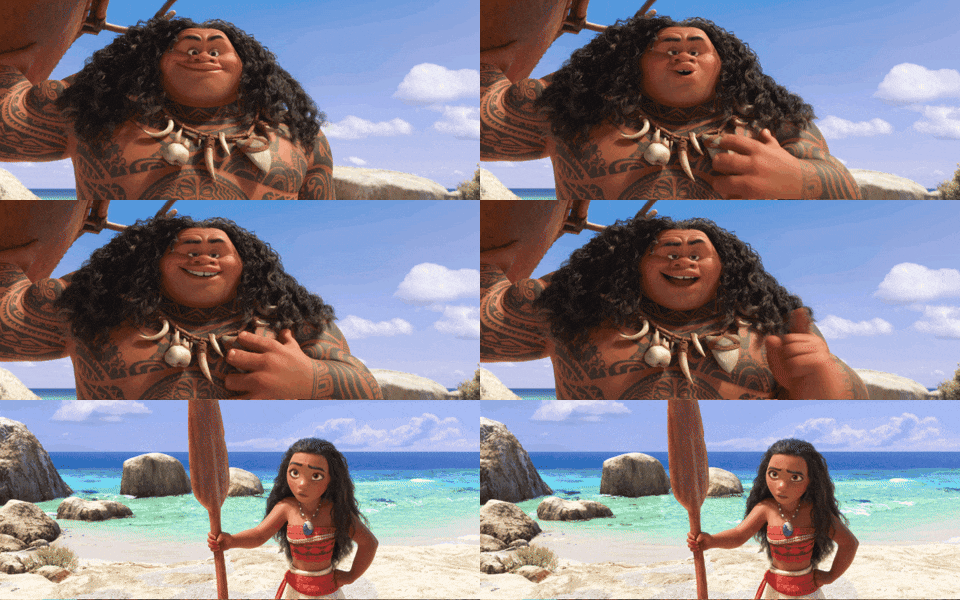
We never get the full story of how/why Maui stole the Heart of Te’Fiti. He probably just wanted its power like all the other baddies in the movie. But Maui is a fun character. Especially when he has a shark head. Shark-head Maui is the best Maui!
 |
| Giphy |
My favorite thing about the movie? The music. Oooooh, the music! When I heard Lin-Manuel Miranda singing “We Know the Way,” I knew it was real.
Moana is definitely a family-friendly film. There are some scary moments when Moana and Maui take on the lava monster, and some rude humor to watch for. But it's very clean and uplifting.
Overall, I like Moana even better than Frozen. This is the Disney movie I’ve been waiting for.
Gender Roles: Moana versus Maui
One of my small concerns/critiques about this film is how it portrays and projects gender roles in the contrast of Moana and Maui.
The island society that Moana comes from is fairly egalitarian. The men and women of the island may have separate roles but they aren’t discussed and it doesn’t make them better than the other. Moana is next in line to become chief after her father. She is never picked on or demeaned or told to do something because she is a woman. Maui calls her a princess but that’s about it. As far as gender roles, this is about as level a playing field as we’ve ever gotten for a Disney film.
 |
Enter Maui. The story revolves around fixing a mistake that Maui made, and at the outset Moana expects him to do it himself. However, he ends up backing out of the venture and Moana has to save the day. Maui is also a more comical character than Moana. His physical strength, magic powers, and knowledge of wayfinding and lore are important to the story. However, he is a trickster responsible for the calamity in the first place and a shape shifter. He’s a braggart. The audience is not supposed to respect Maui or idolize him as much as Moana--even though Moana is being pedestalized for reasons that don’t embody traditional femininity.
Here’s the thing: you can’t jump to the conclusion that just because Moana is the hero that all men are jerks or that women don’t need men to save the world. Because Maui came back to help her and it took both of them to deal with Ta’ka. Yes, selfishness of the Maui variety is an actual problem. Yes, people need to put that selfishness aside to help each other. It is a message that transcends gender or gender roles.
But there is something to be said about the fact that male Disney characters keep being maligned as unfaithful and narcissistic. Most Disney heroes and princes--most of them, NOT all--are either underdeveloped or emasculated in some way. Maui is no exception. He’s a rounded character but not really a traditional hero with a moral compass. He has super-strength but he can’t really do anything without his magic fishhook, and he needs Moana’s help to get the fishhook back, but this also supports the point that he and Moana can’t accomplish anything without help from the other. Maui’s masculinity is a caricature. Moana isn’t a perfect person, either, but it’s not as easy to see her flaws. Moana and Maui are great characters, but is it possible to create a strong female character without marginalizing the male in some way?
Ta’feti/Ta’ka was definitely female but other than that had no real personality beyond her fire duality. She was a goddess and characterized as one. She doesn’t really behave as a person. So Disney hasn’t had a good female villain since Mother Gothel. But Ta’feti/Ta’ka isn’t really a villain. She simply IS.
 |
| Beautiful fan art (Pinterest) |
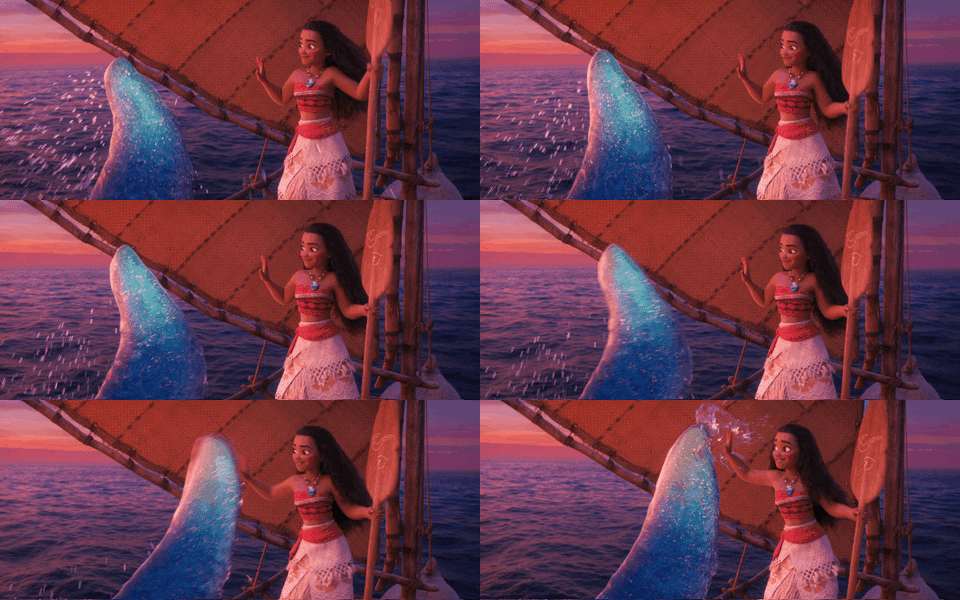
Forgot to mention: the ocean. It's definitely gender-fluid in every sense of the term. Maybe based on its relationship with Moana it's a little feminine. The ocean is never really explained except for the fact that it "chose" Moana. But I wonder why they needed to make the ocean crest into a hump whenever it wanted to interact with Moana? Other than to make it distinguishable. There are plenty of things they could have done. Just a small nitpick.
As far as gender, I don’t think this movie is saying anything radical. That can be a good thing. To a point, gender is not as irrelevant to the subliminal message as you think. But the film is careful to tie Moana back to her people and her family. I'm not saying I have a huge problem with this. It's just something I wanted to point out.
The Music
The music of Moana is a voyage in itself. Lin-Manuel Miranada, we already know, came into the spotlight as the composer for the Broadway musical Hamilton. One of the peculiarities of Hamilton is the way that different lyrics and meloides are attached to certain characters and then repeated in different songs to tie the show together. We see the same technique at work in Moana. Grandma Tala’s line “who you are” first appears in “Where We Are.” Then it gets repeated in “I Am Moana” and “Know Who You Really Are,” and it even gets referenced by the crab Tamatoa in “Shiny.” “I am Moana” is probably the best song in the whole movie because it blends together the themes from “Where We Are,” “How Far I’ll Go” and “We Know the Way.” With the slant rhymes, the rhythm of the words, the visual imagery in Shiny and the rap in “You’re Welcome,” we know that we’re dealing with a master hip-hop artist here. However, Miranda is also a master at more traditional Disney melodies. “How Far I’ll Go” and “We Know the Way” are my two new favorite songs. "Shiny" is the best Disney Villain song since freaking "Mother Knows Best," and it has a vibe similar to "Friends on the Other Side" and "Friend Like Me." Also, may I mention that unlike Frozen and Tangled, we get a reprise of "We Know the Way" at the very end of the movie. Major points.
The Mythology of Moana
Moana does not recreate Polynesian mythology straight from the myths, but it is more accurate to its source material in the details than Hercules or Pocahontas--not that those were bad movies; Moana is just better.
This is what the big picture looks like in Moana’s world. Creation is either the result of divine benevolence (Ta’Feti) or accident (Maui). Other miscellaneous beings--Ta’ka, the Kakamora, and the sea monsters--don’t have any real relationship to humans to benefit or harm them intentionally, but if you bother them they will bother you back. If you have something they want, though, good luck.
 |
| Business Insider |
The humans in this story stay on the island away from other creatures (the island is a “safe” zone”), find purpose and order in their lives in carrying on their traditions, living their lives, and staying in boundaries. It is when they have been on the island too long without leaving or changing that Ta’ka’s curse begins to sap away at the life of the island. The island peoples have to expand in order to survive but Moana and Granma Tala are the only ones on their island who recognizes this. The only world that anyone knows is the island and everything else is legends.
 |
| Giphy |
The voyaging ancestors of Moana’s people found purpose in exploring a bigger world, in expanding their domains and being connected to different islands. They did not limit their resources to a single island which is a lot more practical in an economic sense as well as a spiritual one, and Moana’s story illustrates both of these aspects.
To conventional audiences, Maui can come across as a jerk. And he is. Because he is a trickster. Everything he does, including acts that result in creation, are for kicks (“that was just Maui messin’ around). He isn’t necessarily good or bad. He’s just self-motivated (although the mini-me in his tattoos lends a human touch by acting as his conscience). He is a shape-shifter. His identity is fluid, so while it can benefit him to change his shape, you also can’t trust him because you don’t know who he really is.
What Is the Message?
Who am I? That is a question I have been asking myself a lot lately. Am I supposed to be a responsible adult? CAN I do the things I’m supposed to to take care of myself? Is being a geek and a writer and a dreamer something I can do on the side, or is it going to keep me from being who I’m supposed to be?
Moana spends the film asking herself the same questions. And like her, I am drawn to the horizon of what I it is possible for me to do with my talents. If I can do everything in my power to achieve my goals, who knows what I can create? Who knows where I can go, what I can do, who I can meet, who I can be? That’s the tantalizing question.
Moana is about finding out who you really are. And not just for the heroine. Is the dumb chicken just a dumb chicken? Can Maui be Maui without his fishhook? And does Ta’feti, the benevolent creator, need to be Ta’ka, the fuming destroyer, just because her Heart was wrongfully taken from her?
“I am Moana,” sung by Grandma Tala’s spirit and by Moana after Maui ditches her on the high seas, is the most powerful moment in the film. It is okay if you have to give up. It’s okay if you fail, says Grandma. I will be with you. What matters is who you’ve become because of what you’ve experienced. What matters is that you ARE capable. And what matters, Moana decides, is that she CAN finish the mission herself.
 |
| nicktheilart.deviantart, via Pinterest |
The nice thing about Art, including animated films, is that you can interpret it however you want, and there is not a 100% correct answer to what a piece of art is absolutely about.
It can look like, to some people, that the message of Moana is to go and do whatever you want with your life and don’t worry about your family obligations or their values etc. And that is a valid interpretation. But here is my perspective as a person of faith: sometimes doing the thing, including doing the morally RIGHT THING, can mean going outside of the boundaries that other people set. Or even boundaries you set yourself.
Now, forbidding people to leave the island was kind of a stupid idea in the first place. And Moana didn’t leave just to follow her dream of sailing the seas: she did it to save her people. The fact that voyaging was her dream gave her the courage to pursue that option. Her people’s food supplies were threatened. It was a matter of life and death. If they didn’t change their fishing grounds or make contact with other islands to trade for food, they were going to DIE (talk about your cheese getting moved). Moana had the courage to voice a different idea. She had the courage to take action and do something that would solve the problem. But doing that required her to be different. She spent her life doing everything in her power to fit in and be a good girl but in the end she had to be an agent of change.
I had a thought during my church services last week. You don’t have to conform to what the world thinks you should do. Strength comes not from giving in to your carnal desires or doing whatever you want. Nor does it come from listening to people who say that doing so is the secret to happiness. Strength comes from doing what you believe in.
 |
Sometimes having standards is what makes you different rather than what makes you a sheep. Sometimes the way you interpret your standards or work within the boundaries is going to come across to some people as going outside an accepted limit. Sometimes, events beyond our control make us different from the crowd and you get labeled for it. Sometimes you don’t reflect the image of what other people think an ideal person should be--the truth is, you never do. Sometimes what you believe in your heart isn’t going to be the same as the way everybody else thinks even if you identify with that group.
Moana is a film that speaks to everybody. Because it is a film about being different. Because it is going beyond the accepted limits that carries you to fulfilling your destiny. And sometimes your destiny can be doing more than even you dreamed.


