Showing posts with label Broadway. Show all posts

Monday, June 19, 2017

At the Beginning (Again) With 'Anastasia'

I’m over the moon about the new Broadway musical Anastasia. Because it’s based on one of the movies that defined my childhood.

Related image
Christy Altomare as Anastasia (justjared.com)

I remember seeing it in theaters, and then when it came out on VHS my mom said I had to clean my room before I could watch it. I cleaned my room and I watched it. And then I watched it again and again and again. Granted, it was years before I could sit through the nightmare scene (I had that problem with a lot of movies). But I learned all the songs. I knew all the quotes by heart. I loved having a heroine who both (a) kicked butt and (b) wore beautiful dresses. No, seriously, SHE. SAVES. THE. DUDE. AND SHE BEATS THE BAD GUY. SHE FREAKING KILLS HIM. That had NOT been a thing in animated princess movies before then, to my knowledge. And the shot where she steps on the reliquary is immensely satisfying. #GirlPower

And ‘Anastasia’ is just the most beautiful, perfect princess name ever. Not only that, but, as Vlad says in the movie, “The name ‘Anastasia’ means she will rise again.” Funny, how the musical is breathing new life into the fandom. It’s really amazing to be seeing this happen on the Internet.

self-generated


If I had to pick my favorite non-disney animated movie, it would be a tie between Anastasia and Thumbelina. It just did something for me that few other movies could. The story, the animation style, the music...no movie satisfies me the way Anastasia does. The themes and the story tie into a lot of my other fandoms--and, yes, I can’t help noticing the connection with a certain Soviet super-assassin with a metal arm. Hence I feel the need to share this crossover fan art:

Comrades in Love
Is that Bucky and Natasha or Dmitri and Anya? Yes. (Pinterest)

The movie was my gateway drug to all things Russian. The fairy tale led me to the story of the real Anastasia. The real Anastasia led me to Russia’s beautiful history and culture--golden-domed churches, curved kokoshnik tiaras, Ivan the Terrible, Moscow, Catherine the Great, and of course Saint Petersburg.

One of the other impacts was that it gave me a taste for stories about amnesiac princesses--that became a common trope in some of my childhood daydreams. Also magic necklaces.

When I was older and recovering from the trauma that was middle school, I felt like I had to find myself again. That was when the songs “Journey to the Past” and “Once Upon a December” became real to me.

Related image
Hello Giggles

My freshman year at BYU I took an introduction to sewing class. During the lab period the other students and I would take turns playing our music. One day, “At the Beginning” came on and some of our classmates said they’d never heard it before. The rest of us thought that was ridiculous. So a few lab days later, we watched Anastasia in class so they could get the reference. The professor happened to come down that day to check on us--she told us we couldn’t watch movies in lab anymore. But it was worth it.

(Not to mention, I went to a friend's wedding last Friday, and you'll never guess what song they played for the bride and groom first dance).

The last time I sat down to watch the movie was right before I graduated college. More recently, I was able to buy the movie soundtrack at a thrift store. I don’t listen to it nearly as much as I ought to.

Also, this happened on Tumblr a couple years ago:

Tumblr screenshot

I was neutral bordering on, I’ll admit, a little hesitant when it was announced that Anastasia was going to be revamped for a Broadway musical (although I couldn’t tell you why). But the soundtrack, the photos and the stage footage we have seen about it in the last few months is nothing short of phenomenal. It’s really brought back the magic. I have an aunt who is going to see Anastasia on Broadway in September and let me tell you I am so jelly.

The new musical makes significant changes to the story and some of the classic songs as well as adding a lot of new material. I don’t really miss Rasputin and Bartok, tbh. But the changes they made for the stage were a tribute to the real history of the Russian Revolution, the Romanovs, and what came afterward. And honestly, those changes make me want to see it even more.

Because
Just like
Every other
Nineties kid
I went home
And learned about
The real
Anastasia
And I learned to like
that version too

And I can understand the need to make a story originally produced for the big screen fit better for a 2-hour stage performance where all you have to work with are humans. I took a Theater 101 class in college. Film and stage share some elements of visual storytelling, but the stage is three-dimensional and tactile to an audience and some story elements cannot be conveyed to the same effect as they would on screen. You have to tell the story differently. Yet the nods we do have to the original film give you chills: the blue gown that Anya wears to the ballet, the absolutely stirring performances of “Journey to the Past” and “Once Upon a December,” a few measures in “Stay, I Pray You” borrowed from “In the Dark of the Night”, the ghosts of the Romanov family. It’s familiar and brand new at the same time. .
Related image
justjaredjr I mean HOOOOLY CRAP

I was able to listen to the soundtrack almost all the way through last weekend, thanks to YouTube. Christy Altomare brings an innocence and freshness to Anya’s character, at least in her singing. “In My Dreams” is my favorite new song. It’s a waltz like “Once Upon a December,” but with more major notes, and it conveys the depth of the loss and trauma that Anya has experienced as well as her hope.

I can’t really say much about the new villain, Gleb, without having seen the stage show. But the songs he sings hint at not only his internal conflict but his keen awareness of how revolutions bring out the worst in humanity. And the point is, the bad guy wants to kill her.

I have to admit, I don’t really like the new finale. Probably because I was expecting a reprise of “Journey to the Past,” “Once Upon a December” kind of kills the optimistic vibe about Anya choosing to be herself and go with Dmitri. But, I haven’t actually seen the performance and I don’t know when I’m going to, so I’ll give the jury more time to deliberate on that. So far I still like the movie better--but the musical does a lot for me. It can stay.

Image result for anastasia broadway
Pictaram

I don’t blame the creators of the stage version wanting to go back and explore some of the themes that were hinted at in the film, because there is a LOT to work with.

The Soviet Union and Communism was never mentioned directly in the movie, although we had a couple of cues (Vladimir’s passport, the “People’s Orphanage,” people calling each other comrade. The musical, however, lets us know all about that.  In the new version of “A Rumor in Saint Petersburg,” we open with a speech from Communist party leaders and people complaining about bread lines, and a brief mention of Saint Petersburg being renamed Leningrad. I went to a Russian Choir concert at BYU around easter, and the choir sang a lot of wartime Soviet ballads--let me tell you, “Stay, I Pray You” really draws from that genre. But it also conveys the idea that Russia is still Russia no matter who is in charge of it.
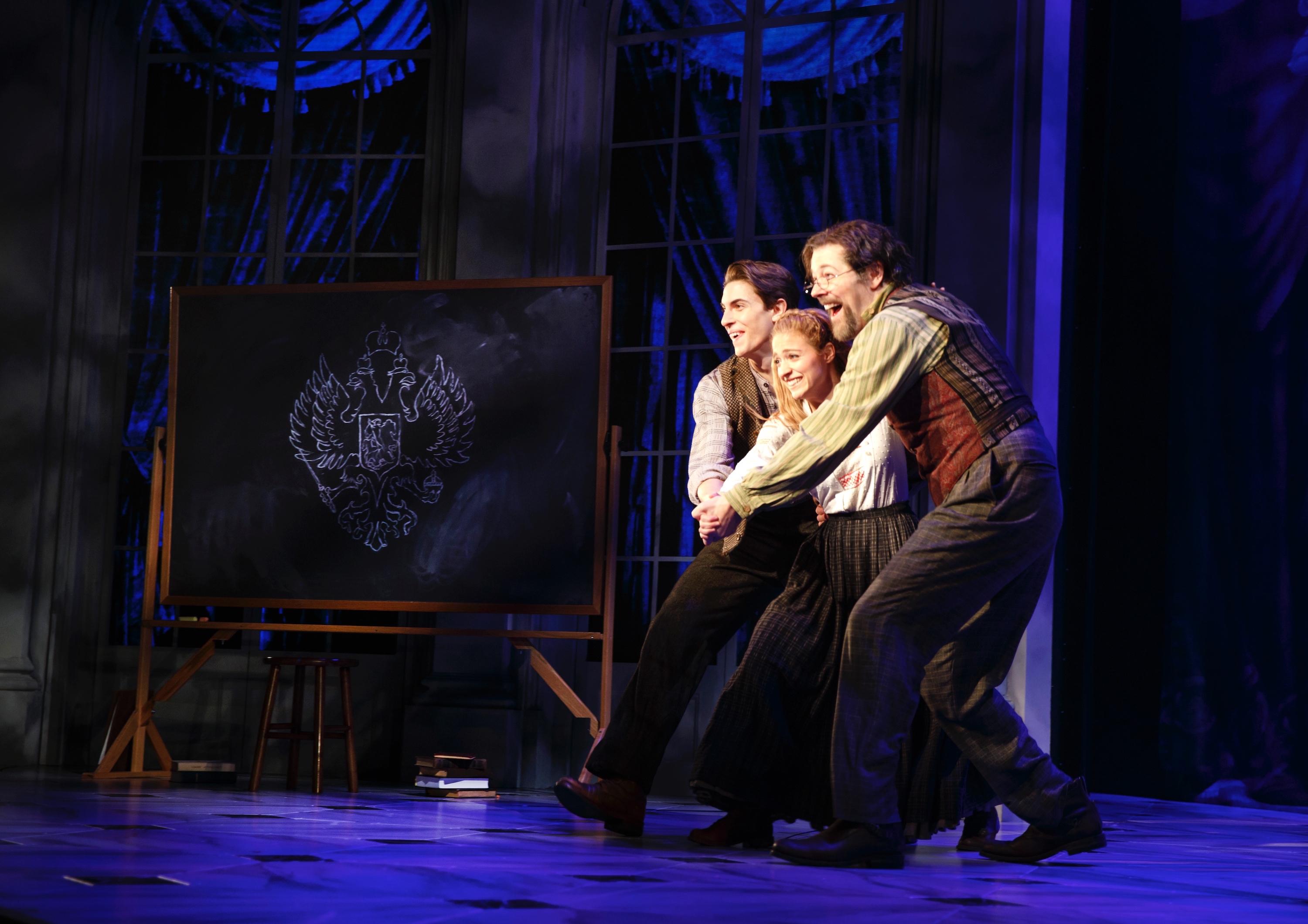
Image result for anastasia broadway
Dmitri, Vlad, and Anya in the Hartford stage production (pre-Broadway) (Hartford Stage)

Anastasia is the story of a young woman who is trying to figure out who she is in terms of both where she came from and who she can be, a journey from the past (Saint Petersburg) to the future (Paris). If you know anything about history, you would know that Paris during the roaring twenties is a major artistic and intellectual hub for people suffering post-World War I Disillusionment. The musical shows us the Russian expats who escaped the Revolution and expressing their bitterness in “Land of Yesterday”. In real life, we had a lot of American expats living and writing in Paris at the time, most notably Gertrude Stein and F. Scott Fitzgerald. A person who walks into that kind of a scene might be provoked to ask certain questions. World War I destroyed a lot of faith that people had in the old way of doing things--monarchy, empire, aristocracy, religion, morality, and so on. Paris, more relevant to the story overall, represented the forward-thinking and forward-mindedness of the future, and it is a place where Anya has to come to terms with what she really wants. Russia at the time is a Communist country where the government dictates the economy and brainwashes people to be loyal to the State, it represents stagnation. Capitalist, glittering Paris is a gateway to opportunity, freedom, and exploration of self.

The movie is probably best thought of as a fantasy that represents working through your inner demons. Rasputin and his minions are a reminder that childhood is, from a child’s perspective, scary. The things that are trying to separate you from what you want are simply understood as monsters and demons and dark magic. You also live in a world where adults say one thing but mean something else. If you don’t believe me, someone at The Atlantic had similar comments to say about Jim Henson’s Labrynth. But, anyway, back to Anastasia, the movie goes to show, those monsters can be slain. The “good magic” if any, comes from what is safe and familiar--the ghosts of her lost family, the lullaby, finding her grandmother again.

The Broadway musical, I guess, is about adulthood, about transitioning into the world emotionally and spiritually. You’re physically an adult, but inside you still have to do some growing up. It is also a reflection of today’s world where there is so much social upheaval and young adults like me go through a lot of displacement, from home, to college, to the job field, and then the challenge of trying to figure out who they are. Anya’s stage journey from Saint Petersburg to Paris is an analogy of this, where we’re coming from versus where we’re trying to get to. Which brings me to another point: somehow I relate more with the lost Anya the Orphan than the snarky teenage IRL Anastasia, because Anya doesn’t know who she is or where she belongs, and she has to find that out for herself. And that’s a journey people tend to get lost on.

I wish I could write like this movie's writers. The story between Anastasia and Dmitri is beautifully done.
One of the most important meta posts ever written about any movie (Pinterest)


Just because we have this new version of the Anastasia legend does not mean we have to discard any version that came before. The good thing about telling stories is that they can be told over and over again. And if you tell a story in a different way each time, then you learn something new from it. It's still something you can enjoy without being uptight about the (lack of) historical accuracy. The important thing is not who or what Anastasia is about but about the journey the characters go on, and what we learn from going with them. The message has always been, and will continue to be, that following your heart is the most important thing. When you know who you really are, then everything else will fall into place. Anastasia is a story that was important to me in my childhood and teen years. It is a story that I continue to find a lot of meaning in.

anastasia's journey
20th Century Fox/Pinterest

Saturday, June 18, 2016

Liz on "Les Miz"

Last month for cleaning checks I had the first act of the Les Miserables 25th Anniversary Concert playing in the background. For this month I did act two.

I've been thinking a bit about Arizona lately since it's my second home. Arizona is important to me for a number of reasons. One of them should be, perhaps, the fact that Arizona is where I had my first exposure to Les Mis. It was the night before Girls' Camp. It was my first year and was going with my cousin's stake. While my cousin and her friends were outside playing in the pool, I went inside while my aunt was cleaning house. She had the original cast recording of Les Miserables playing while she worked (hence I guess the association with Les Mis and cleaning). I remember that some of the songs were fun to listen to.

Via Mi Isla Creations

We were at Camp LoMia over Sunday, and that night we had a fireside with Jenny Prince, whose theater camp I had been in for the last two summers. Jenny told the story of Jean Valjean's change of heart at the beginning of Les Mis--but at the time I had no idea that it was part of the same musical that my aunt was listening to the other day.

My junior year of high school, I moved to Snowflake/Taylor for a year. Best experience of my life. One of the reasons that was the case was my English class with the late Ms. Carolyn Cunningham. Ms. Cunningham required us to write up three book reports per semester on reading we had done on our own. One of the books available for our reports from her collection was an abridged version of Les Miserables. Ms. Cunningham told us at the beginning of the school year--heck, it may have been the first day of school--"If you don't read Les Miserables while you're in high school, you are not human."

Stagedoorish

There were a lot of things I learned from Ms. Cunningham that I took to heart. That line about Les Mis must have been one of them. I checked out the abridged version in January. Between all of my other assigned readings for Ms. Cunningham's class and the homework for my other classes (I was in nearly all honors/dual credit courses) it was slow going. But it was in class that I read about Jean Valjean's conversion. I finished Les Mis at the end of February. I loved it. I was just blown away by the feeling I had while reading it--like drinking orange juice. It made me feel excited. That was about all of the story that made sense to me at the time. I was able to keep the plot straight, but I couldn't quite put my finger on what the major themes were.

I've had the Mormon Tabernacle Choir album Showtime since high school and it's one of the CDs I have listened to OVER and OVER again. So I was familiar with the song "Bring Him Home." But I didn't quite have the context for the song after reading the book. I had yet to see the musical in any form.


Junior year, of course, was when Susan Boyle happened. I was blown away by the video like everyone else, but the song "I Dreamed a Dream" really spoke to me at the time.

In 2012, two things happened. The movie version of the musical came out. I have yet to see it, but for now let's just say Honest Trailers (link) and recommendations from other friends have ruined the chances of that for the time being. But 2012 was also when Alfie Boe guest starred with the Mormon Tabernacle Choir for their annual Christmas concert. I had the privilege of being able to attend and watch him sing Bring Him Home IN PERSON. There is nothing quite like that. And I have never heard louder cheering in the Conference Center than when he performed that.


I have an aunt on my mom's side who LOVES Alfie Boe. She got me a copy of the Les Mis 25th Anniversary Concert on DVD in 2012, so that was how I finally saw the musical all the way through. I have watched it a handful of times, but it's an amazing experience every time. The 25th Anniversary concert in particular is when you get the reunion with four previous casts and it's awesome (I may just be biased but Alfie is the best Valjean. In any event, he's my Valjean).
Via makinghugospin.livejournal. Too good to pass up!

I haven't seen any other versions of the musical but I would like to.  I really regret not seeing it when Provo High School did it a couple years ago. (I also saw the non-musical movie starring Liam Neeson not long ago--it was an okay movie, a little different). I've heard from some friends that I'm not missing much by not reading the unabridged version of the novel. We'll see if that happens. And now I'm in the bad habit of listening to "One Day More" the day before a major movie comes out.

I think what has helped me to understand the story is listening to the musical over and over again, and paying attention to the story and the words. After his conversion, Jean Valjean spent his life serving others. He did what he could to help Fantine, and then he gave Cosette the best life possible. And then he rescued Marius so that he and Cosette could be together. Social justice and revolutions can only do so much. It is individual acts of service, kindness to others, and love that truly changes the world. "To love another person is to see the face of God." I truly believe that.

And I don't care if there are restrictions on being a Les Mis fan. I don't care if I don't have the most cultivated taste on Les Mis. I am a fan whether you want me in or not.

Tuesday, March 1, 2016

You Had Me at "Hamilton"

It started when one of my theater geek friends posted a link to a news article on Facebook. Of course, with a name like Hamilton, and the premise being the story of an influential figure from the Revolutionary War period, a history buff like me couldn’t pass it up.
That was about the same time, of course, that the show became all the rage on Tumblr.  GIFs and fan art started appearing everywhere. I listened to most of the soundtrack while working on a sewing project and had a great time.

my edit

So for the record, I have heard of Alexander Hamilton. Anyone here remember the show “Liberty’s Kids” from back in the day? Young Colonel Hamilton’s first and most memorable appearance on that series was his ride with James to Morristown, where he shared his backstory about being orphaned in the Caribbean.  He didn’t mind being with James, since they were both “Gentlemen of Low Birth.” But other than that I never really paid attention to Hamilton, in real life or otherwise.
The real Alexander Hamilton was actually kind of a big deal.  I knew he fought in the Revolution and he was close to Washington.  I had no idea that he was pretty much Washington’s right-hand man. I knew he was at the Constitutional Convention but I didn’t know much about his participation. I knew that James Madison wrote a few of The Federalist Papers and John Jay added a few but I didn’t realize that “Hamilton wrote the other 51.”  I also knew that Hamilton was the first Secretary of the Treasury--hence why he’s on the ten-dollar bill.  But I had no idea that he helped Washington run the country during his first term as president and that a lot of his initiatives created the America we have today.  
Needless to say, I have not looked at a ten-dollar bill the same way since Hamilton came out.

Hamilton the Man

After listening to the soundtrack highlights, I decided to check out the eight-hundred-page Ron Chernow biography that inspired Lin-Manuel Miranda so I could learn more about this guy. Though I am an introvert I am a people person and a sucker for biographies: the best way to learn about history is through the lives of the people who shaped it. I got through half of it before Christmas.  I had to return it and I only just recently re-checked it from the library. 

Alexander Hamilton was many things: a war hero still ambitious for military glory after the fighting had ended; a loving husband and father as well as a scoundrel; a scholar and a diplomat, a finance guru, a lawyer; a loyal friend; an enthusiast of medicine; a politician who pushed his own ideas as well as a realist who understood the world around him; but most importantly to me personally, a writer.  True, a much different kind of writer than me, but someone who put his thoughts on paper.  The line from the musical “Why do you write like you’re running out of time” is not only accurate but it convinced me that, more than any other founder, Alexander Hamilton is my spirit animal.


Every founding father was brilliant in their own way, but they were so adamant about their different ideas that they couldn’t get along.  I am reminded of a statement that Joss Whedon once made about the Avengers: they don’t belong in the same room together.  Putting all of the big names in the American Founding together for the administration of the first president may have worked to unify the country at the start but it ended up creating the party system as people rallied to different figureheads. Chernow successfully argues that Washington was not Hamilton’s puppet, as Thomas Jefferson would have you believe, but that while he took lots of advice from Hamilton he was a moderating influence and tried to placate both of the parties. And while he did favor emulating British systems of commerce and industry, he was very, very much American.
Most eighteenth century figures I admire are brilliant in their intellectual and/or military talents but have really reprehensible personal lives. John Adams was the perfect family man and did a lot of great stuff, but he had temper issues and he was super insecure as a president.  Thomas Jefferson was not only immoral but he was also a jerk towards Hamilton and the Federalists. James Madison was less immoral and more of a jerk because he was so close to Jefferson.

Via CBS News.com

Alexander Hamilton was a great family man, no doubt about that.  I prefer to think his affair with Maria Reynolds was disappointing but his only real dalliance--it was more like David’s affair with Bathsheba. But Hamilton’s true strength was in his intellectual prowess and in paving the way for an America built on industry, trade, urban development, and finance.  Chernow indicates that Hamilton was a man ahead of his time. Southerners like Madison and Jefferson didn’t see that relying on an agrarian-based economy was not the way for America to get ahead.  Hamilton, a self-made man, knew how to make a country in the same way.  Hamilton also saw that there wasn’t anything wrong with trade relations with Britain and he saw the French Revolution for the chaotic mess that it was.

Hamilton: the Musical

Being a history geek, I already knew the Founding Fathers were humans.  It’s nice that the Broadway musical has convinced its fans of the same idea. The multi-ethnic casting, as well as Miranda’s inspiration for the show correlating the story to modern rap battles and street fights, makes Hamilton’s story applicable and real to today’s audiences. It used to be that people complained about living in a country founded by dead white guys.  Newsflash: those dead white guys had feelings, they had struggles, they were human. Hamilton fans GET IT. And Hamilton also teaches and reinforces the idea that America is a place where anyone can succeed, including people who are originally from somewhere else.  
The musical also depicts how Hamilton’s self-motivation was also his Achilles’ heel.  He was so determined to make something of himself that he pushed other people out of the way.  It made more sense to him, for instance, to confess his adultery publicly than to let the world believe he had been abusing his office as Treasury Secretary, effectively putting the world before his wife’s feelings.

Hamilton musical:
via Pinterest

I am a huge fan of anyone named Elizabeth.  Eliza Schuyler is no exception, and with her show-stopping numbers in Hamilton--“Helpless,” “That Would Be Enough,” and “Burn”-- Miranda creates a very three-dimensional portrait of an extraordinary but hitherto unrecognized woman in history. Chernow’s biography makes it clear that Alexander leaned on Eliza so much for emotional and spiritual support.  The musical shows her as someone who took her own initiative to make herself part of the story--Hamilton’s story, which, in a sense, is America’s. Eliza is a great character in the show because she’s an independent woman but at the same time someone in love with Alexander and a devoted wife and mother.  It is relieving to see a woman in those domestic roles portrayed in such a positive and influential light.

Lin-Manuel Miranda<<< has gorgeous hair:
Lin-Manuel Miranda as Alexander Hamilton, via Pinterest
The Broadway show also gives a sympathetic perspective of Aaron Burr.  History tells us that Hamilton disliked Burr because he was a politician who changed his stance to suit his needs. In the show, we get the incredible solo “Wait for It,” the “Stars” to Burr’s Javert.  Hamilton rushes around and grabs life by the horns.  He does what he thinks is right.  Burr takes his time, taking opportunities to advance himself from elsewhere rather than creating his own future.


Conclusion

Hamilton is another instance of me jumping on the bandwagon, but I have gained, and continue to gain, a lot from this latest fad personally. I’m not a huge fan of the explicit language in the lyrics or the chorus doing sensual dance moves in eighteenth-century underwear (although it’s an interesting visual device in the theatrical sense). I am also not a huge fan of rap or hip-hop, but I do like it occasionally as long as it's clean and catchy. I am a fan of men in eighteenth-century costume and Lin-Manuel Miranda ROCKS IT! More importantly, I am a fan of what Hamilton represents: making the past real and relatable to the present, and paying tribute to the contributions of a heroic founding father.